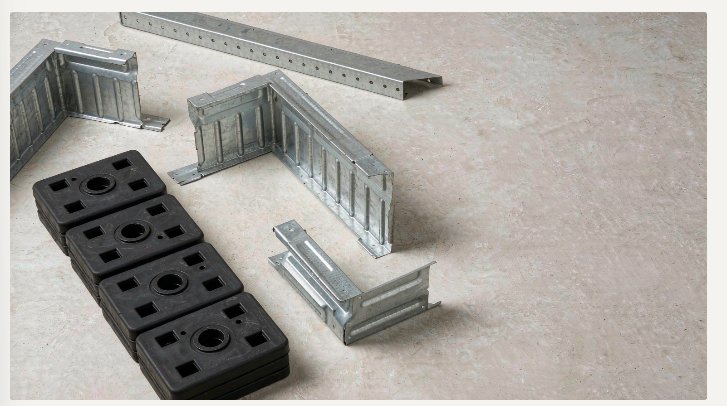
Vibration pads, wall brackets, duct covers and support feet — the four things that decide how an outdoor unit behaves. We supply them as one set. 34 standard models in stock, tooling to your drawing, mixed loading in a 20′ container.

Four categories from one supplier: fewer purchase orders, no mismatched specs
34 standard models, from 1 HP residential units to commercial multi-split
Tooling from your drawing or sample; production starts after sample approval
Mixed models, export packing, complete loading data and shipping marks
Unit model, load, wall type
By bore spacing and load
From your drawing or sample
Test fit, then freeze dimensions
Built to the approved sample
Mixed containers, replenishment
LIANZHAN manufactures and supplies installation parts for HVAC outdoor units.
We believe a reliable installation comes down to four things: vibration is isolated, load is carried properly, refrigerant and drain lines are protected, and the details are finished. So the range is not a loose box of parts — it is built around those four points: pads for vibration, brackets and feet for load, duct covers for routing and sun protection, sleeve covers and clips to finish.
Our customers are HVAC contractors, regional distributors and equipment makers. Their three standing requirements are simple: the model must match, the lead time must hold, and the container must ship complete. Those are also our three internal KPIs.
The unit hung on the bedroom wall. The owner reported a constant low hum at night; the original bracket was thin angle steel with no elastic separation between unit and bracket.
Switched to thicker rubber pads with full contact under the feet, and added diagonal bracing to reduce bracket vibration.
Structure-borne noise dropped noticeably; re-measurement met the building requirements and the same detail was applied to identical units in the block.
Brackets for the multi-split units had been in service for years: coating corroding, some anchors loose. Replacement had to be phased without closing the mall.
Re-selected hot-dip galvanised brackets by unit weight, added 100 mm feet to solve standing water, delivered in three batches with night work.
All three batches finished inside the window with no impact on trading; maintenance now follows a batch ledger.
A distributor needed several models in one shipment, but each model had its own MOQ, which would have left half a container empty.
Combined models to reach container volume, printed buyer marks, supplied packing list and load plan.
One 20′ container shipped with five models and complete documents; the mix is now a quarterly repeat order.
Not always. When the unit hangs on a rigid bracket with a bedroom on the other side of that wall, vibration travels through the structure — pads make an audible difference there.
On a separate base or a roof, check first whether there is an actual noise complaint before adding them.
Measure the bolt spacing on the unit feet, then check the unit weight. Matching both is the reliable route.
1–1.5 HP residential units usually take the small single- or double-hole sizes; 3 HP and above, or commercial units, need the thicker high-load models. The A / B / C dimensions in the spec table map directly to the foot spacing.
Size the bracket at twice the unit's total weight or more, and check the wall material.
Solid brick or concrete takes wall brackets; lightweight walls or insulated facades are better served by floor feet that transfer load straight to the slab.
Current ducts are PVC, ivory white as standard, which matches most residential units.
Bulk orders can be produced to a colour card — send quantity and colour code and we confirm MOQ and lead time.
Leave your requirement — we reply the same day with model, price and lead time.
Or contact us directly: phone +86 133 7847 4583 · email shuer516788@gmail.com